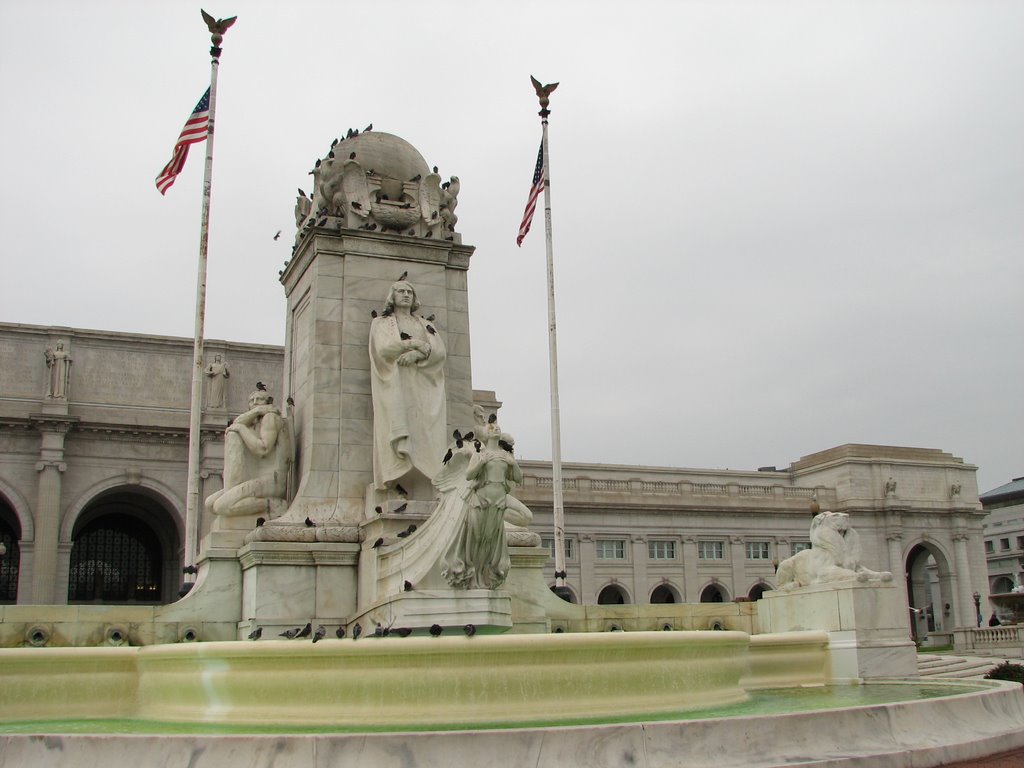
We were so tired from yesterday's tour we woke up quite late. By the time we went to the breakfast area, the staff is already cleaning the tables and packing the food away. Good thing there's a box of donuts left. Yum! To get to the National Mall, again it's a bus ride from Arlington to Pentagon, then take the Metro to Union Station. It was raining the whole morning, so I didn't get the chance to take some outdoor shots of the Union Station. First landmark we visited is the Supreme Court building. The Supreme Court has quite a bit of history. The first session of the Supreme Court convened on February 1, 1790,
  but it was not until 146 years later when it was provided with its own building. Architech Gilbert Cass chose to give the building a Neoclassical look from ancient Rome. The cornerstone was laid on October 13, 1932 and construction completed in 1935. Out of $9,740,000 allotted by Congress, $94,000 was returned to the Treasury. Now that's a miracle!
The main entrance of the Supreme Court building is on the west side, facing the Capitol Building. Flanking the main steps to the entrance are two seated figures by sculptor James Earle Fraser. On the left is the Contemplation of Justice. On the right is the Guardian or Authority of Law. The facade of the building uses marble quarried from Vermont.
 Sixteen Corinthian columns support the western pediment or portico. If you look closely, you'll see words "EQUAL JUSTICE UNDER LAW" engraved on the architrave. You'll also see a sculpture set done by Robert Aiken representing Liberty seated in a throne and guarded by figures who represent Order and Authority. On either side are groups of three figures representing Council and Research.
What most people don't know and don't see is the east side of the Supreme Court building. Above the columns are the words "JUSTICE THE GUARDIAN OF LIBERTY" inscribed on the architrave.
 The sculptures on the eastern pediment are done by Herman A. McNeil, representing three great lawmakers: Moses, Confucius, and Solon, flanked by symbolic groups representing Means of Enforcing the Law, Tempering Justice with Mercy, Settlement of Disputes Between States, and Maritime and other functions of the Supreme Court. There was a bit of controversy when the sculptures were first unveiled as they have some religious connotations. (Yeah, as if In God We Trust doesn't). MacNeil was able to get out of that one by explaining that, "Law as an element of civilization was normally and naturally derived or inherited in this country from former civilizations. The 'Eastern Pediment' of the Supreme Court Building suggests therefore the treatment of such fundamental laws and precepts as are derived from the East." Nice one, dude.
 Entering the bronze doors, you get to the Great Hall with two rows of marble columns rising up to the ceiling and busts of former Chief Justices displayed along the walls. At the end of the Hall is the Court Chamber. Some bits of interesting trivia: its walls and friezes are of Ivory Vein marble from Alicante, Spain; and its floor borders are Italian and African marble. For the Courtroom's 24 columns, Gilbert felt that only the ivory buff and golden Siena marble from the Old Convent Quarry near Liguria, Italy will do. So he wrote to Benito Mussolini for his assistance in acquiring some. Another interesting feature of the building is the self-supporting elliptical staircase designed by Cass Gilbert.
  I quote from the board on the wall: "Each of the two staircases has 136 steps that complete seven spirals while ascending five stories from the basement. The cantilevered desing of the staircases alleviates the need for a central support. Each step is anchored into the marble wall on one and and rests upon the step below it. The steps, therefore, are held in place by fit and pressure." And what do we have on the fourth floor? A basketball court, also known as "the highest court in the land."
 After the rain has weakened a bit, we rushed to the Library of Congress. Sounds a bit boring, but I tell you, the architecture inside the Library is awesome. If you have enough time to join the guided tour, I strongly suggest you take it. A little history first. The Library of Congress was first established by an act of Congress in 1800. Established with $5,000 appropriated by legislation, it was housed in various spaces in the new Capitol from 1800 until August 1814,
  when invading British troops set fire to the Capitol Building, burning and pillaging the contents of the small (3000-volume) library. Within a month, former President Thomas Jefferson offered his personal library of 50 years as a replacement. In January 1815, Congress accepted Jefferson's offer, appropriating $23,950 for his 6,487 books, and the foundation was laid for a great national library. With the introduction of the copyright law of 1870, which required all copyright applicants to send to the Library two copies of their work, the Library experienced a shortage of shelf space. Librarian of Congress Ainsworth Rand Spofford convinced Congress of the need for a new building, which Congress authorized in 1886.
  And thus, the Thomas Jefferson Building came into being.
Now, on with the tour. From the ground floor where the Visitor Center is, we take the stairs to the first floor. Normally, the main entrance to the first floor would be through three 3.5-ton double bronze doors, depicting Tradition, Writing and Printing. Nowadays, these are opened only for special occasions. We now find ourselves in the West Corridor or Entrance Vestibule. Take a close look at the ceiling, and wish that parts of it fall down,
 as that's real 23 karat gold leaf. Around the edge of the ceiling are 8 pairs of statues by Herbert Adams; each pair consisting of a Minerva or War and a Minerva of Peace.
Once in the Great Hall, you'll know this is the centerpiece of the Library. The flooring is of whiteItalian marble. In the middle of the floor is a large brass inlay shaped like a sun.
 The ceiling is 75 feet high and decorated with stained-glass skylights. Flanking the Great Hall are two grand staircases embellished with sculptures of cherubs by Philip Martiny. These putti represent the various occupations, habits and pursuits of "modern life." Halfway up the railing are cherubs represnting Asia and Europe (on the north side) and Africa and America (on the south side). Upon the newel post at the base is a bronze female figure wearing drapes and
  carrying a torch of knowledge.
At the center of the east side of the Great Hall is the Commemorative Arch. Above the arch are the words LIBRARY OF CONGRESS written in gold, in case people get lost. Beyond the Commemorative Arch is the East Corridor. The East Corridor features a vaulted ceiling covered with mosaics honoring Americans and their achievements in a variety of professions: painting,
 poetry, engineering, natural philosophy, architecture, natural science, music, sculpture and astronomy. Here, you'll notice two glass cases on either side of the corridor. These cases contain the treasures of the Library: the three-volume Gutenberg Bible (only one of three perfect vellum copies in existence) and the Giant Bible of Mainz. Understandably, no photography is allowed. On to the second floor, it's more marble floors, mosaic portraints, paintings, etc. There's another staircase which leads to a visitors' gallery from which you can view the cavernous Main Reading Room. Again, no photography allowed, so as not the distract the people below. I could go on and on and on, but we really have to move on. Also, at this point my camera batteries ran out.
 Next up is the Capitol. The Capitol Building is quite easy to identify. It's the white building atop Capitol Hill at the end of the National Mall with the Neoclassical dome, the rotunda, and the two wings, one for each chamber of Congress: the north wing is the Senate chamber and the south wing is the House of Representatives chamber. Fearing that we might destroy the building with our cookies and potato chips and bottled water, the security staff asked us to dispose of them before we enter the site. The place is pretty busy and crowded.
  Amidst all the tourists and tour groups and security people and building staff, we lost our way. Apart from the Congress chambers, there's really not much else to see. You can't loiter around too long because the place is not a museum, and the security people tell you to keep on moving. We inquired about the central dome, and was told that it's not open to walk-in tourists today, and that we need to join a tour tomorrow. Since this is our last day in Washington, the security lady took pity on us and pointed us to a stairway that leads to the dome. The rotunda is bigger than I imagined - 96 feet in diameter and 180 feet in height. Right in the middle of the concave canopy is a fresco called The Apotheosis of Washington painted by Italian artist Constantino Brumidi in 1865. It shows Washington rising up to heaven and becoming a god.
  Just below the belt of 36 windows is the Frieze of American History - not really a frieze with bas reliefs, but a frescoed panorama of selected 19 scenes from American history. Brumidi started work on the scenes in 1878. After Brumidi's death, Filippo Costaggini continued the work, following Brumidi's sketches. I was able to only take two pictures before we were noticed by a security guard, and were requested to leave the place.
Next stop is the Lincoln Memorial, which is a leisurely walk from Capitol Hill. The Lincoln Memorial's architecture is in the form of a Greek Doric temple with 36 columns surrounding the central chamber.
 Inside is a massive sculpture of a seated Abraham Lincoln done by Daniel Chester French using white Georgia marble. It is 19 feet tall and 19 feet wide. On the wall above the statue is the following inscription:
IN THIS TEMPLE
AS IN THE HEARTS OF THE PEOPLE
FOR WHOM HE SAVED THE UNION
THE MEMORY OF ABRAHAM LINCOLN
IS ENSHRINED FOREVER

On the south wall is inscribed the Gettysburg Address, while the north wall carries his second inaugural address. Trivia time: If you look closely at the second inaugural address, there's actually a typo - EUTURE instead of FUTURE.
Just a few meters away is the Korean War Veterans Memorial. Within the memorial triangle are 19 stainless steel statues of soldiers on patrol - 15 Army, 2 Marines, 1 Navy Medic, and 1 Air Force Observer. On one side of the memorial is a 164-foot long black granite wall with photographic images sandblasted into the wall. Very nice effect. You have to stand further a bit to really see the images. Right in front of the soldiers is a plaque inscribed with the message:
 "Our nation honors her sons and daughters who answered the call to defend a country they never knew and a people they never met 1950 - Korea - 1953".
On the other side of the Lincoln Memorial is the Vietnam Veterans Memorial. It's basically made up of three structures - the Vietnam Veterans Memorial Wall, the Vietnam Women's Memorial, and the Three Soldiers statue. The Wall is made up of two long granite walls (75 meters long and 3 meters high) placed at an angle of 125 degress to each other.
 On them are inscribed the names of all the servicemen who fought in the Vietnam War - 58,249 names as of 2005. One little known fact is that the memorial is actually designed by a student of Chinese ancestry by the name of Maya Lin. She was then an architecture student at Yale University, and designed the wall as a class project. Out of 1,421 entries for the design competition, hers was chosen, but her name was not even mentioned in the dedication ceremony because of her Asian heritage, which was a sensitive issue then.
Just nearby is The Three Soldiers (a.k.a. The Three Servicement). That bronze sculpture also has its share of controversy. It was commissioned as a result of the negative reactions to Maya Lin's original design. The protesters didn't like the fact that Lin's concept doesn't look like a traditional war memorial -
 no bronze statues, no patriotic writings. To appease the protesters, Frederick Hart (who placed third in the original competition), was asked to design the statue. Naturally, it was Lin's turn to feel displeased that her design was adulterated without her permission. She refused to attend the statue's dedication on Veteran's Day, 1984. The Three Soldiers depicts three young men (White American, Black American, and Hispanic), looking at the wall from a distance. South of the Wall is the Women's Memorial, dedicted to the women who served in the Vietnam War. It was designed by Glenna Goodacre and dedicated on November 11, 1993.
Would've been nice to spend the rest of the day exploring all those museums on the National Mall - the Smithsonian, the National Gallery of Art, the National Museum of Natural History, etc. Unfortunately, it started raining even harder, so we have no choice but to go back to the hotel and call it a day.